
£2 Billion Under Our Streets
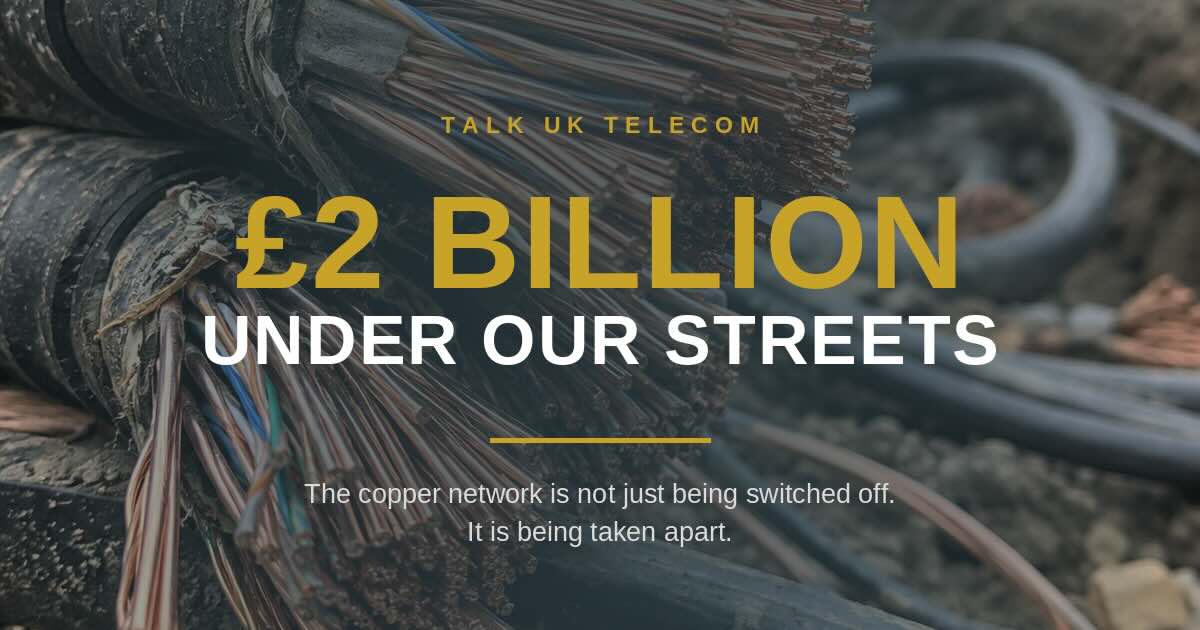
£2 Billion Under Our Streets
That’s what BT’s old copper network could reportedly be worth.
Not a building. Not a business. Not some shiny new piece of technology.
Copper.
Up to 200,000 tonnes of it, much of it forming part of the vast telecommunications network that has connected Britain for generations.
And as the UK continues its move away from copper towards fibre, BT Group could reportedly generate more than £2 billion from recovering and selling it.
It’s an extraordinary number.
But perhaps even more extraordinary is thinking about just how much copper is actually down there.
A network built over generations
For decades, copper has been at the heart of Britain’s telecommunications network.
It runs from exchanges, through cabinets and underground ducts, along our streets and into millions of homes and businesses.
Every new development, additional telephone line and expansion of the network added more.
And when newer infrastructure was installed, the old cable wasn’t necessarily dug back up and removed.
So, over decades, an enormous physical network was built beneath our feet.
Now, as fibre replaces much of that infrastructure, parts of the old copper network are gradually becoming redundant and can be recovered.
And we’re not talking about a few old cables.
Estimates suggest up to 200,000 tonnes of copper could eventually be recovered from BT’s old network.
More than 22,000 tonnes has reportedly already been recovered since 2023.
Yesterday’s technology. Tomorrow’s raw material.
There’s an interesting irony to all of this.
Copper may be disappearing from our traditional telecommunications network, but demand for the metal itself certainly isn’t disappearing.
Quite the opposite.
Copper is a hugely important material for electrification and is used across renewable energy infrastructure, electric vehicles, electronics and data centres.
So we’re removing copper because telecommunications technology has moved on, at precisely the time other technologies increasingly need it.
Yesterday’s telecoms network could quite literally become part of tomorrow’s technology.
There’s something rather brilliant about that.
It’s easy to forget what’s actually changing
We spend a lot of time in telecoms talking about the move from copper to fibre in terms of technology.
Faster connectivity. Fibre broadband. Digital phone services. The retirement of the old telephone network.
But this story puts the sheer physical scale of that transition into perspective.
This isn’t simply a change happening on a computer screen somewhere.
It’s a network that has been built over generations.
Cables. Cabinets. Exchanges. Ducts.
Thousands upon thousands of tonnes of infrastructure that most of us walk or drive over every day without giving it a second thought.
And now, bit by bit, some of it is coming back out.
Potentially 200,000 tonnes of it.
Worth more than £2 billion.
Who knew there was quite so much money sitting underneath Britain’s streets?
The old network isn’t just being switched off.
It’s being taken apart.